
Good SME businesses are genuinely excellent at reactive service. It helps them wipe the floor with larger, bureaucratic competitors and it creates long term loyalty in markets with low switching costs. But it has a ceiling. Unless the SME can unlock a way of becoming a proactive, strategic partner, then larger and longer standing clients become vulnerable to competitors who do become trusted advisors.
Reactive Performance Great, Proactive Not so Much
Customer service is the highest-rated dimension across our entire 5 year dataset of commercial reviews. Its average rating is 4.63 out of 5. This means two thirds of customers rate it a perfect 5/5 and almost no one rates it less than “Good.”
It is the main driver of retention for SME suppliers. In sectors as different as aviation compliance software, lone worker safety, healthcare diagnostics, and MRO distribution, responsiveness is the main reason customers stay. Several retain clients for over a decade in markets with objectively low switching costs, sustained almost entirely by service quality.
In contrast, for 27% of companies customers highlight lack of proactivity as a weakness. A further 16% customers want improvements in proactive support. This combined total is greater than the biggest SME weakness of key person dependency.
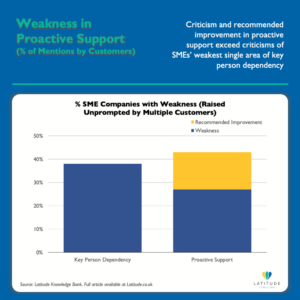
It gets expressed in different forms: wanting proactive advice about how they should better apply the supplier’s service, best practice guidance, creative suggestions and fresh thinking, etc. But the broad theme of proactive input is the same.
Not a single customer of any of the businesses reviewed over 5 years said they got too much proactive advice and support.
Which Customers Want Proactive Advice
Customers complaining most about lack of proactivity are senior buyers, larger clients, and longstanding clients.
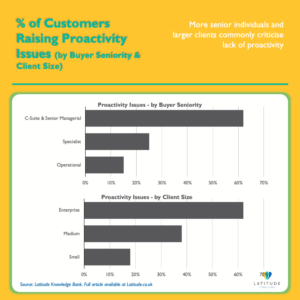
C-suite or a senior directors expect suppliers to contribute strategic thinking. Operational and functional contacts care more about responsiveness and reliability.
Large clients are more complex and forward looking, and they need more in depth justification for decisions.
First-time buyers are often delighted simply to have a supplier who responds quickly. As relationships mature, “solve my problem quickly and well” is already a given. The longer the tenure, the more likely the request for proactive support, with complaints about lack of proactivity growing roughly 25% for every additional year of tenure.
Consequences of Poor Proactivity
Lack of proactive support has direct commercial consequences.
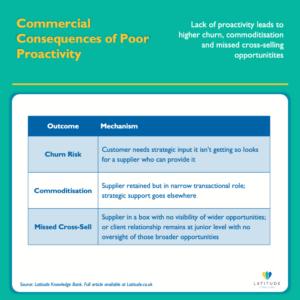
The flip side is that proactive support creates a partnership premium. Businesses in our sample the strongest proactivity credentials, showed stronger revenue expansion intent from existing clients.
How to Create a Proactive Capability
Having a proactive capability does not spoil reactive support. In our sample there was no relationship between proactive capability and reactive service scores.
Companies that successfully created proactive support shared three major characteristics, that non-proactive players lacked:
- Technical or domain expertise in client facing roles, rather than front end sales backed up by technical teams
- Deliverables that were framed in terms of client outcomes, e.g. RoI or sales uplift, versus operational measures
- Embedding advice into the service, e.g. quarterly strategy meetings
Two other important but less prevalent factors were having structured rather than ad hoc feedback loops to capture improvements, and participation in client planning cycles.
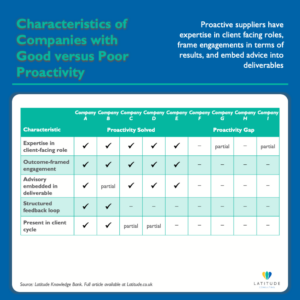
None of this requires complex bureaucracy. One outstanding example of such proactive support with all these characteristics is a product technology company that has only 2 full time staff.
It also doesn’t require across the board changes. Focusing on larger and long standing clients, and on senior buyers addresses the bulk of situations demanding proactive support.
To Grow Above the Ceiling, Get Proactive
Reactive service excellence wins clients and retains them — it is a genuine strategic asset. But it is not sufficient for the largest clients, senior staff and the longest relationships. Those are asking for a qualitatively different engagement: one that anticipates rather than reacts, that shapes thinking rather than solves immediate problems. Businesses that provide this are described in the language of partnership. Businesses that do not are described, politely, as reliable suppliers.


