
Novel Product Companies Fail When Treated Like Mature Ones
A founder with deep industry connections launches a product that solves a real problem. Early adopters love it. But 18 months later, growth has stalled and churn is climbing. 3 years later, the company has settled into what seems like a long flatlining slog. The problem? Treating a novel product company like a mature one. Big drivers of value in mature companies like product improvements and sophisticated marketing can be fatal to novel product businesses. Instead, success comes from easy discovery through tight networks, heavy investment in user uptake, and patience with margins. Here’s what commercial reviews of novel and mature product companies from Latitude’s knowledge bank reveal about these distinctions.
Novel Product Company Discovery
Novel product companies have no brand awareness, no established buyer base looking to renew or change supplier, no established customer budget to fit within, and no ITTs specifying their product. Formal marketing is usually ineffective and potential customers trying to discover the answer to their problem have no idea what search term to use even if they think they need the product. Instead, novel product companies rely on their founders to preach the word and on champions to spread the word.
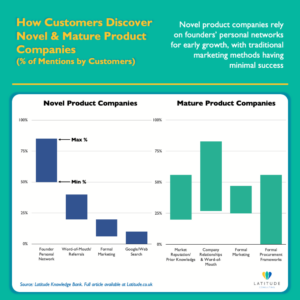
Novel product companies acquire 50-85% of customers through founder personal networks, while mature companies rely on established market channels.
The Role of Founder Networks in Novel Product Company Discovery
What distinguishes novel product companies with a strong stream of new business from those scratching around is how close knit the founder’s network is, assuming the founder is well known and respected within that network.
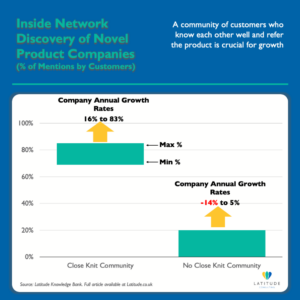
Close-knit founder communities drive 16-83% annual growth in novel product companies. Without strong networks, growth stagnates between -14% and +5%.
For one fast growing novel agtech product business, 85% of customer acquisition came through the founders’ network – a tight-knit group of growers who trust each other’s technical recommendations. A website sales enhancement business, without a close community of buyers, saw 0% network discovery and never escaped company-led direct sales.
Without a close knit community of referrers, the job of persuading strangers to try out a novel product remains with the founder and possibly their team. No acceleration, no network effect, just a relentless speaking and persuading treadmill. The only genuine additional source of new clients to the founder’s efforts is any enthusiastic users moving into new job roles, which is a slow and random process.
Selection Criteria – What Novel Product Buyers Actually Care About
Buyers of novel products are by definition uninformed and typically not from purchasing. They have no predetermined selection criteria or purchase process, and they have no pre-established budget for the novel product. What they really care about is getting a return on investment and solving their problem, which means a product that is easy to use and lots of service hand holding to make roll out happen. Because the product is new to them, they very often use trials to assess the value of the product before any serious roll out.
Critical Supplier Selection Criteria (Range of Responses)

Novel product buyers prioritize trial-based ROI and ease of use over price. Mature product buyers have confidence in delivery and compare on functionality and price.
Return on investment comes in as many forms as there are customers, but the key characteristic is showing a benefit to the customer that they consider worth the investment. The novel product company wins the business by over delivering on the trial, which usually requires exceptionally high touch service levels.
The critical mature product selection criteria of price and functionality are subsidiary to RoI, until the product becomes more mature and buyers have alternatives to compare it with.
Novel Product Company Retention & The Crucial Role of User Uptake
The overwhelmingly most important performance challenge for novel product companies is user uptake. The product is not part of companies’ established workflows or job performance requirements and needs momentum creating behind it.
Uptake is essential to retention, which is a black and white issue for customers of novel products. These novel products customers don’t have regular market reviews or retender rules. If uptake is high it almost always creates a strong RoI. So customers keep the product or roll it out further. If usage falls off they stop using it or look for an alternative.

User uptake creates a 2-2.5x difference in novel product company outcomes. High uptake (90-100% coverage) drives 90-100% retention versus 40-60% retention and constrained growth with low uptake.
Product excellence cannot make up for other factors that reduce uptake. In a typical example, a specialist HR tech provider scored an excellent 4.1/5 for product quality and an almost perfect 4.7/5 for service but suffered 60% usage-driven churn. A sales tech provider, with almost identical ratings, had 0% churn because of its obsessive uptake support.
Successful novel product companies stimulate and support this uptake by keeping the product simple and as easy to use as possible, and supporting it with continued high touch service to make implementation smooth.

Novel product companies excel at customer service (4.8/5) but trail mature companies on implementation ease and functionality. This service advantage drives initial sales but can be undermined by added complexity.
This starts going wrong for novel product companies when they start adding features and functionality. Product “improvements” that reduce ease of use – adding steps, creating a new and unfamiliar interface, even replacing one big button with 3 smaller ones – can create drops in customer satisfaction and move retention from 100% to below 60% with one upgrade.
This is then reflected in much wider performance variability for novel product companies compared to their mature product counterparts. Low scoring novel product companies are overwhelmingly those that added product complexity.
| Lowest Overall Rating | Highest Overall Rating | Range | |
| Novel Product Companies | 2.4 | 5.0 | 2.6 |
| Mature Product Companies | 3.8 | 4.9 | 1.1 |
Novel Product Company Margins
Despite a lack of competitive alternatives, the work involved in the sell, free or low scale trials, and typically low revenue per customer combined with ongoing high touch service make the early years of novel products low margin years.
The transition comes when the product stops being novel: customers know what it is, have budgets for it and ask for it; users have it in their work flows and the company can support them with the basics. This is the time when margins move from barely covering operating costs to PE grade returns.
The transition typically takes 3-5 years for successful novel products: the time needed to build awareness, establish budgets, and embed in workflows.
The mistake is to rush this transition and try to enhance margin before the product is mature enough, because support, uptake and growth will suffer badly.
Novel Product Company Due Diligence Checklist
Here’s what to look for:
- A tight knit community of buyers and referrers
- A founder from that community who has strong relationships and reputation
- A high usability product with an obvious RoI for the customer
- Excellent service
If any of these is missing, you’re in for a long hard slog.
Growing a Novel Product Company
An instinct many novel product company managers have is to enhance the product and charge more for it, or create suites of complementary products. The instinct is often egged on by a few enthusiastic customers who ask for more features or functionality.
The problem with this is that adding product capability without making the product more difficult to use is almost impossible in most situations. This is fatal to a novel product, creating churn in existing customers and making successful roll out much more difficult in new ones.
Product enhancements that don’t get in the way of ease of use are fine, but aren’t the heart of the matter. The core growth strategy should be penetrating existing customers and adding new ones until the product isn’t novel any more. After that then the normal rules apply.


