
Customer Uniformity (Part 2)
Suppliers to customers with uniform requirements have a good thing going. They have more satisfied customers, with higher renewal rates, higher satisfaction with pricing despite often being high margin. And they have lower cost customer acquisition from peer referrals. This was all covered in our part 1 article.
This leads us to 2 big questions. If I’m one of those suppliers, how do I keep on this attractive path? If I’m not one of those suppliers, how do I get on it?
Let’s start with the first question and look at the 2 big challenges these suppliers face to keep on their path: staying on top of product development, resisting over stretch. Once they’ve been successful for a while, they have another challenge, which is running out of road. But that’s another subject for another day.
Product Development Challenges
High uniformity suppliers are insulated from the effects of having an outdated or underperforming product. If we look only at companies with low product and technology satisfaction, companies with non-uniform customers had terrible overall satisfaction and poor renewal. But those with highly uniform customers still had high overall satisfaction and renewal rates.
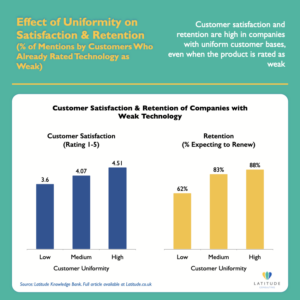
So, for the non product-obsessives, the prompt to update the product just isn’t there; and the business case for improving the product can look weak. This is a time bomb. Good competitors, with more modern products, eventually come in to fill the gap.
The good news is that continued development of a focused product is something that SMEs can do better than their less focused, often larger competitors. All they need to do is keep putting senior attention and monthly budget into their core product, and resist cash cow mode that puts the next version at some vague date in the future. The focus also needs to be on making the core product better, not just bigger. This leads us to our second challenge.
Resisting Over Stretch
Adding services, features and functionality is tempting. Financially, the incremental revenues from established customers can make an attractive business case, much more so than putting budget into improving a core product that existing customers have already paid for. Strategically, becoming a one-stop-shop for customers feels like nice positioning.
This functionality proliferation has two big drawbacks. First, customer satisfaction can go down as the previously easy to use product gets a bit more clunky and clicky with each new addition. The customer just doesn’t have the bandwidth. Second, it can create a vicious spiral of under development as each of the new product legs needs to be developed and supported. In this case, the supplier doesn’t have the bandwidth.
We very often see uptakes of 100% on a core product, 70-90% on secondary modules, and 30% down to low double digits on tail modules. The further away from the core workflow, the faster the drop off. The cost and distraction of the tail modules can kill the quality of the core in all but the most mature companies.
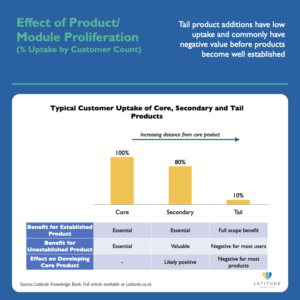
Products do need to be improved and customers do want more functionality as they integrate products into their ways of working. But the focus of development too often results in adding functionality too quickly to the detriment of continually improving the core product.
Becoming Uniform
Turning from all things to all men into a supplier into uniform situations is a strategic decision, and strategy is about sacrifice.
Thinking about target markets, this means prioritising fit over opportunity, and deprioritising low fit markets, even if they’re enormous. Lengthy investigations into total addressable markets for SMEs pull the decision in the wrong direction when the overriding factor in the decision should be competitive distinction and unique attractiveness.
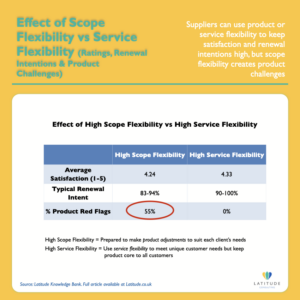
Thinking about the customer proposition itself, it means distinguishing between scope flexibility and service flexibility. SMEs that adapt their products and core service responsively to customer requests get praised for it but create major issues for the future with more than half having product red flags. SMEs that go the extra mile in service responsiveness and customer communication have similarly high satisfaction and retention, but with zero product red flags they don’t make tomorrow more difficult.
Physique, Not Bloat
Successful, focused SMEs with strong uniformity listen to their gym instructors. They resist the tempting revenue snacks that pass their desks, and they never skip product development leg day.


