
One of strongest drivers of satisfaction and renewal rates for SME suppliers is how uniform their customers are. Suppliers with a uniform customer base have high satisfaction and renewal rates. Those with low uniformity don’t.

This uniformity comes in different guises: sector, buyer role, buying prompts and, in current day jargon, “use cases.” But for all types the pattern holds. With a more uniform customer need the supplier can design a better fitting service, and develop narrow and deep expertise to support that customer. They can stay on top of, or even ahead of, developments in the area.
Situation Uniformity vs Sector Uniformity
Maybe surprisingly, situation uniformity (customers having similar prompts to use a service and similar use cases of that service in their company) is a much stronger driver of both satisfaction and renewal than just focusing on a single sector. Serving a range of customer situations is a recipe for poor satisfaction and renewal, even if it’s all to a single sector. Serving a range of sectors can be fine, as long as the customers face uniform situations.
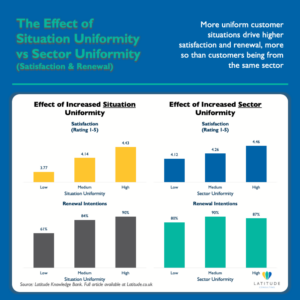
Uniformity of the customer’s situation is the prime driver, but sector focus can still be the icing on the cake. For high situation uniformity customers, tighter sector focus drives satisfaction and renewal from very good to excellent.

Why Uniformity Drives Satisfaction & Renewals
Looking under the hood at why customer uniformity might drive satisfaction and renewals reveals some expected things. It reveals some counter-intuitive things, and some insights that are more important than they look at first sight.
First the most intuitive and obvious insight. High uniformity suppliers typically have excellent service ratings. Uniformity allows suppliers to design the proposition to a specific need with staff who genuinely understand customer problems with a bank of experience to draw from. Overall satisfaction and renewal correlate very strongly with service satisfaction across our database, so this finding makes sense.
Second, and counter-intuitively, product satisfaction has no relationship with customer uniformity. Highly uniform customers give some of the highest product ratings in our database. But other highly uniform customers give some of the lowest. There is no point showing you averages because ratings spread evenly from high to low. Highly uniform suppliers get away with this, as excellent service makes up for any poor product. But it creates a danger for the future, which is the subject of a future article.
High uniformity customers are much more likely to discover suppliers through peer networks. Their users refer the service to peers facing similar problems. This is much more important than you might think. It doesn’t directly drive satisfaction and renewal, but it takes pressure off the front end. This makes business attention much more focused on delivery and service than on new business. It also makes competitive comparison much less likely.
Customers of high uniformity suppliers have lower awareness of competitors. Nine out of every ten high uniformity customers could not name any direct competitors. In contrast, every low uniformity customer could name at least one and usually multiple. As well as the peer discovery effect, this might also come from the increased likelihood of a high uniformity supplier dominating its niche. So there’s genuinely not as many competitors in that niche than can be found across a range of more broad based services.
Finally, pricing satisfaction shows the starkest difference between low and high uniformity suppliers of all our measures. Customers of low and medium uniformity suppliers are dissatisfied with how much they pay. But high uniformity customers are typically pretty satisfied with pricing, even though it is fairly common for uniform suppliers to enjoy quite high margin pricing. This is likely driven by a combination of higher service satisfaction and lack of known alternatives for comparison.

What’s Not to Like?
Suppliers serving customers facing uniform situations have the deck stacked heavily in their favour. Those customers are more satisfied, more loyal, and easier to win through low cost network recommendation. They are less concerned about price, and in the short term forgiving about product weaknesses.
From an investment assessment perspective the uniformity is an excellent leading indicator of likely success on lots of other measures. The challenge comes from a management perspective. How to keep growing and developing if you already have high customer uniformity? And how to create uniformity if you haven’t got it already? We’ll cover this in part 2.


