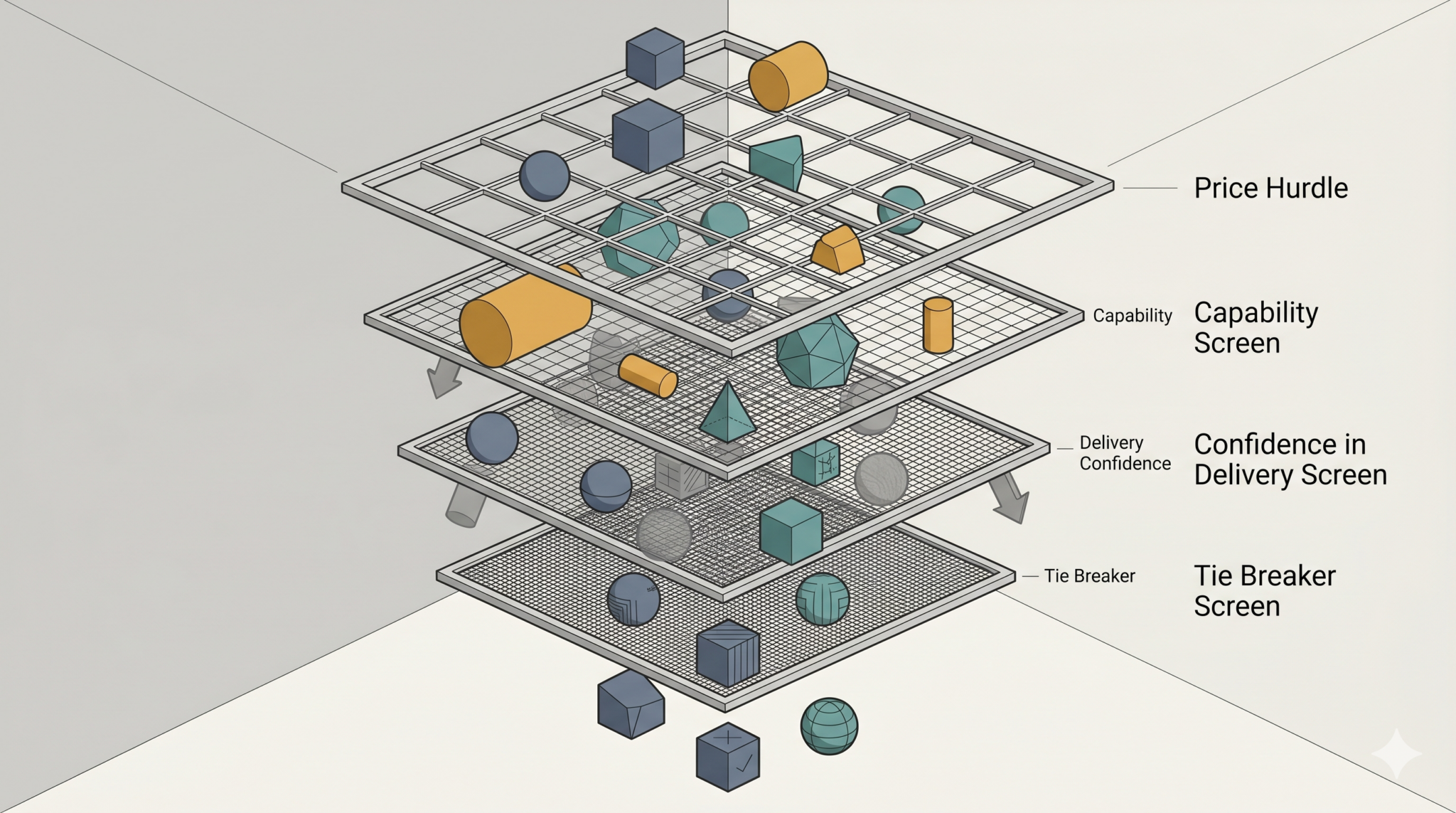
What’s Important Versus Why People Win
Here’s a common framework people use for winning new business: identify what’s most important to customers and perform well in those areas.
Buyers are also taught to do the same thing from the other side: list what’s important to them, give each thing a weighting, and rank suppliers against each.
The problem is that’s not how buyers make decisions.
Here’s an aggregated picture of what’s most important to buyers from 500+ customer interviews in a range of sectors. The chart next to it shows the dominant reason those same customers chose their supplier.
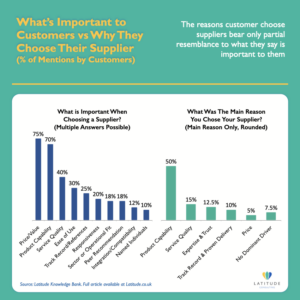
These two lists really don’t bear much resemblance to each other, especially around price but in other places too. So what’s really going on?
Screening & Differentiating
Across the hundreds of customers we speak to, from micro to giant, and in dozens of sectors the pattern of decision making is the same.
- Screen 1: price versus budget for established products, or versus perceived value for novel products
- Screen 2: capability
- Differentiator & screen 3: confidence in delivery
- Tie breaker: a range of factors, including price, to decide between everyone who couldn’t be differentiated on delivery
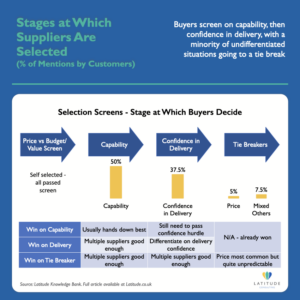
Around half of the time, customers choose their supplier in the capability stage and stop looking further. When no supplier stands out as the winner on capability, then confidence in delivery is the decisive factor. Tie breaks and price-based decisions happen barely more than 10% of the time.
While feedback loops, nuances and exceptions exist, the broad steps follow this order:
- Once suppliers pass the initial hurdle, the one with obviously superior capability wins, provided the buyer trusts delivery
- If there’s more than one with similar capability, then the one that gives the highest confidence in delivery will win
- In the fraction of situations where capabilities are hard to tell apart and more than one supplier gives strong confidence in delivery, then it’s a tie break with a plethora of factors, including price, deciding who wins
Capability
Suppliers can raise the capability hurdle. They can make a product or service so uniquely well designed and valuable for customers’ requirements that customers choose there and then on capability. They still need to pass the confidence in delivery test. But that’s now a screen about being good enough, not a comparison against anyone else.
Suppliers make the hurdle higher in different ways.
- Sector/context specificity – the supplier precisely designs the product for the buyer’s situation
- Niche product or service configurations – nothing is unique but the configuration is, e.g. combinations of hardware, software, data sources and services
- Technical design uniqueness or integration depth – the supplier can embed the product into the client environment or tailored to it in ways that others can’t or won’t
- Quality premium – the supplier provides higher standard content or materials, as defined by buyers’ not suppliers’ requirements
- Proof of performance – a supplier proves performance in the buyer’s situation before commitment in a way that competitors can’t or won’t, e.g. pilot trials, performance with peers
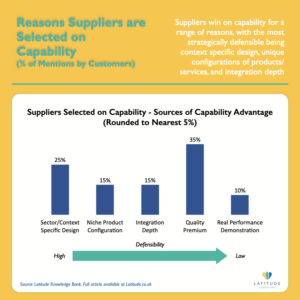
The list goes from most robust to most fragile strategically, as they get progressively easier for a well funded competitor to copy. Everyone who gets through the capability screen is judged on confidence in delivery, which is where the bulk of the differentiation now happens.
Confidence in Delivery
Buyers use three main indicators to judge their confidence in delivery, with much of the information from sales meetings:
- Service quality, responsiveness and relationship signals – the winner out signals competitors by their attentiveness and ease of working with during the sales process itself
- Practitioner expertise and personal trust – again in the sales process, the supplier shows expertise in understanding the customers specific situation and competence in describing solutions
- Track record and verifiable references – typical in more formal buying processes that are often higher stakes with multiple people involved and where sales meeting impressions alone don’t provide enough assurance across the whole decision team

Two further points are worth drawing out here.
First, in many cases, new business competition is against an incumbent. A high performing incumbent is almost impossibly difficult to beat in confidence in delivery. They are usurped either in the previous stage of a materially superior product, or by matching the delivery confidence and winning in the tie break on price or some other measure.
Second, the only confidence in delivery indicator that isn’t strategically vulnerable is track record and references. Everything else relies on key individuals.
The Effect of Market Maturity
In early stage and competitively thin markets, buyers prioritise capability. As markets mature and competitive options and capability grows, confidence in delivery becomes increasingly importance. Price only becomes a genuine deciding criterion in the most mature and commoditised markets.
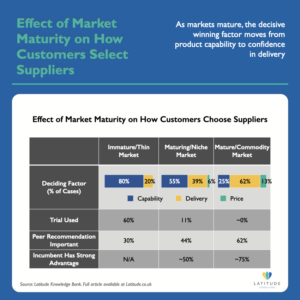
Buyers don’t lower the capability hurdle as markets mature. The hurdle rises as buyers become more knowledgeable and as more suppliers are there to set the benchmark. But at the same time more suppliers can produce a good enough product and get over the capability hurdle.
How Procurement & More Formal Processes Change This
Procurement processes map fairly closely onto market maturity, but there are some additional nuances that come with increasing process structure. In a nutshell, more formal processes mean more people involved with a broader set of requirements, and more hurdles at each stage.
They also rely on scoreable metrics and historical evidence of performance versus personal judgement.
Capability and confidence in delivery remain critical screens. But performance needs to be “good enough” across multiple areas within product capability and within confidence in delivery. The ability to win because of one or two areas of excellence is considerably lower.
Around 20% of the time, the deciding factor is price.
How The Stakes of Getting Things Wrong Affect This
The stakes of getting things wrong affect buying decisions in a few ways:
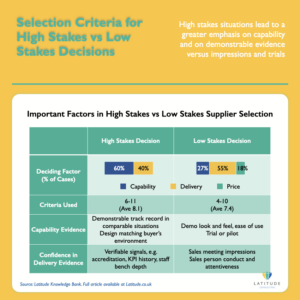
- High stakes buyers prioritise capability, screening out non top tier suppliers ; for lower stakes purchases, confidence in delivery and price matter more
- High stakes purchases require more concrete and verifiable evidence about capability and delivery
- For low stakes purchases, sales meetings carry more weight, with evidence from demos, sales person impressions, and attentiveness
- Buyers, surprisingly, use a similar number of criteria to decide between suppliers whether stakes are high or low; but the type of evidence differs
When Price Really Matters
Price decides the outcome in 5% of our entire sample, and only 20% of the time in the most price conscious situation of procurement led decisions in mature markets. Admittedly this percentage is kept low by favoured suppliers being offered the chance to match the best price by shrewd or process constrained customers.
There are situations in which price does matter:
- When budgets are so constrained that low price becomes a genuine hurdle or when a supplier is so premium priced that the buyer can’t justify it
- When the capability and delivery standards are so uniform and widespread that raising them above market levels is not valued by customers and, for those that passed the hurdle, best price wins
In non-commodity markets, these situations are few and far between.
“We lost on price” is a very common reason given in sales loss analysis. This is customers letting their suppliers down gently. In reality the competitor showing greater capability or gave more confidence that they would do a better job of delivery.


